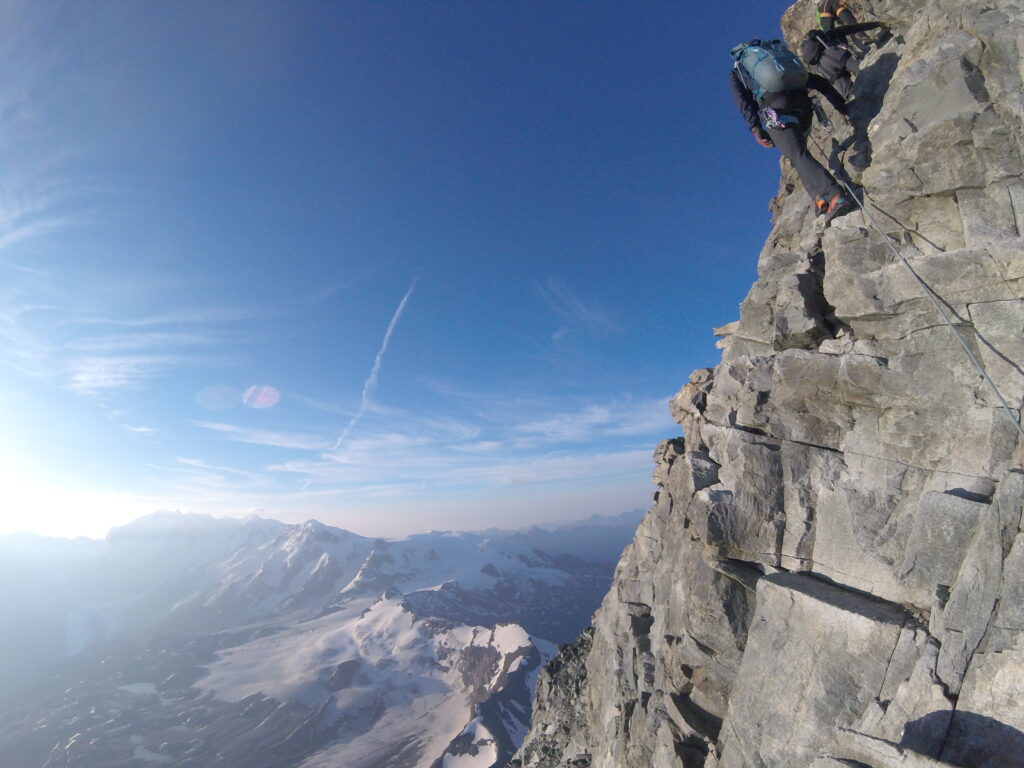
Matterhorn
The Matterhorn is a mountain of the Alps, straddling the main border between Switzerland and Italy. It is a large, near-symmetric pyramidal peak, whose summit is 4,478m high, making it one of the highest summits in the Alps and Europe.
The north face was not climbed until 1931 and is among the three biggest north faces of the Alps, known as ”The Trilogy”.
The Matterhorn was one of the last of the main Alpine mountains to be ascended, not because of its technical difficulty, but because of the fear it inspired in early mountaineers. The first serious attempts were all from the Italian side, although despite appearances the southern routes are technically harder.
Edward Whymper on July 14, 1865, in what is considered the last ascent of the golden age of alpinism, was able to reach the summit by an ascent of the Hörnli ridge in Switzerland.
Climbing routes
Today, all ridges and faces of the Matterhorn have been ascended in all seasons, and mountain guides take a large number of people up the northeast Hörnli route each summer. By modern standards, the climb is fairly difficult (AD Difficulty rating), but not hard for skilled mountaineers according to French climbing grades. There are fixed ropes on parts of the route to help. Still, it should be remembered that several climbers may die on the mountain each year.
The usual pattern of ascent is to take the Schwarzsee cable car up from Zermatt, hike up to the Hörnli Hut elev. 3,260 m, a large stone building at the base of the main ridge, and spend the night. The next day, climbers rise at 3:30 am so as to reach the summit and descend before the regular afternoon clouds and storms come in. The Solvay Hut located on the ridge at 4,003 m can be used only in a case of emergency.
Other popular routes on the mountain include the Italian (Lion) ridge (AD+ Difficulty rating) and the Zmutt ridge (D Difficulty rating). The four faces, as well as the Furggen ridge, constitute the most challenging routes to the summit. The north face is amongst the six most difficult faces of the Alps, as well as ‘The Trilogy’, the three hardest of the six, along with the north faces of the Eiger and the Grandes Jorasses (TD+ Difficulty rating).
Sample itinerary 6- 7 day adventure
- Day 1 – Arrive in Geneva and shuttle to Chamonix. Gettogether and general information regarding the climb + gear check. We will spend the night in a hotel in Chamonix.
- Day 2 – Meet at. in the lobby of the hotel. We will spend the day reviewing and practicing our rock climbing skills in the mountains around ’Chamonix. We will climb the Traverses of the Aig Crouchues above Chamonix. This traverse allows us to practice climbing uphill and descending. We spend the night at a hotel in Chamonix.
- Day 3 – Depart Chamonix in the morning and head up the famous Aig du Midi lift to 3,800 m. We will journey across the large glacier massif (Valle Blanche) over to the Traverse of the Entreves. This is a technical rock traverse mixed with snow, ice, and rock. We spend that night at Torino Hut.
- Day 4 – Early wake up, and leave the hut for an alpine start. We climb up the Dent du Geant (“Tooth of the Giant”), just over 4,000 m with an amazing summit. The “Tooth of the Giant” is not as well known as the Matterhorn, but the stunning ridge and shear beauty of this peak will not be forgotten. On this climb we get time to practice using fixed ropes and moving on technical terrain in our climbing boots. We spend the night at the Torino Hut (alternatively return to Chamonix).
- Day 5 – Walking back across the Valle Blanche in the morning, we then climb the famous Cosmiques Arete. This class alpine ridge line finishes back at the top of the Aig d’Midi, and provides another chance to practice our alpine rock climbing in boots. We will spend the night in Chamonix. In the afternoon we will get our equipment ready for the Matterhorn and go over logistics for traveling to Zermatt.
- Day 6 – We start the day by traveling from Chamonix to Zermatt, either by train or by car. Travel time takes around 3.5 hours. We depart Zermatt mid-day and approach the base of the Hornligrate Ridge, where we ride the Schwarzee lift to 2,575 m. From the top of the lift we travel by foot on a main hiking path to the Hornli Hütte at 3,260 m. In the afternoon, climbers and guides can possibly preview the lower section of the route, if conditions and time permit. We will enjoy dinner and go to bed early in preparation for our ascent.
- Day 7 – Summit Day! Climb the Matterhorn via Hornligrate Ridge, just over 1,200 m (4,000 ft.). This is a technical ridge climb requiring a high level of physical energy and technical ability. The lower two-thirds of the route involve a rock climb and rock scramble. We will take our first long break at the historic Solvay emergency shelter (4,003 m). Climbers should plan on reaching this hut in 2–2.5 hours. With only 475 m until we reach the summit from the Solvay, the route steepens as we ascend the upper Mossey Slabs. The final 200 m of the Matterhorn is on steep snow and ice before attaining the final summit ridge. Our goal is to reach the summit in 4.5–5.5 hours and then reverse our path and descend to the Hornli Hut. We will have a well deserved break, and pack our remaining belongings at the Hornli, before heading back toward Schwarzee lift where we will break for lunch. The adventure ends in Zermatt in the early afternoon. Depart Zermatt via train to Geneva or Zurich. When booking flights, climbers should be aware the train ride is 4–4.5 hours. The first train departs around 5 a.m. Fly back to country of origin.